
Categories
MortgagePublished September 16, 2026
Where Mortgage Rates Stand Right Now — And What's Coming Next

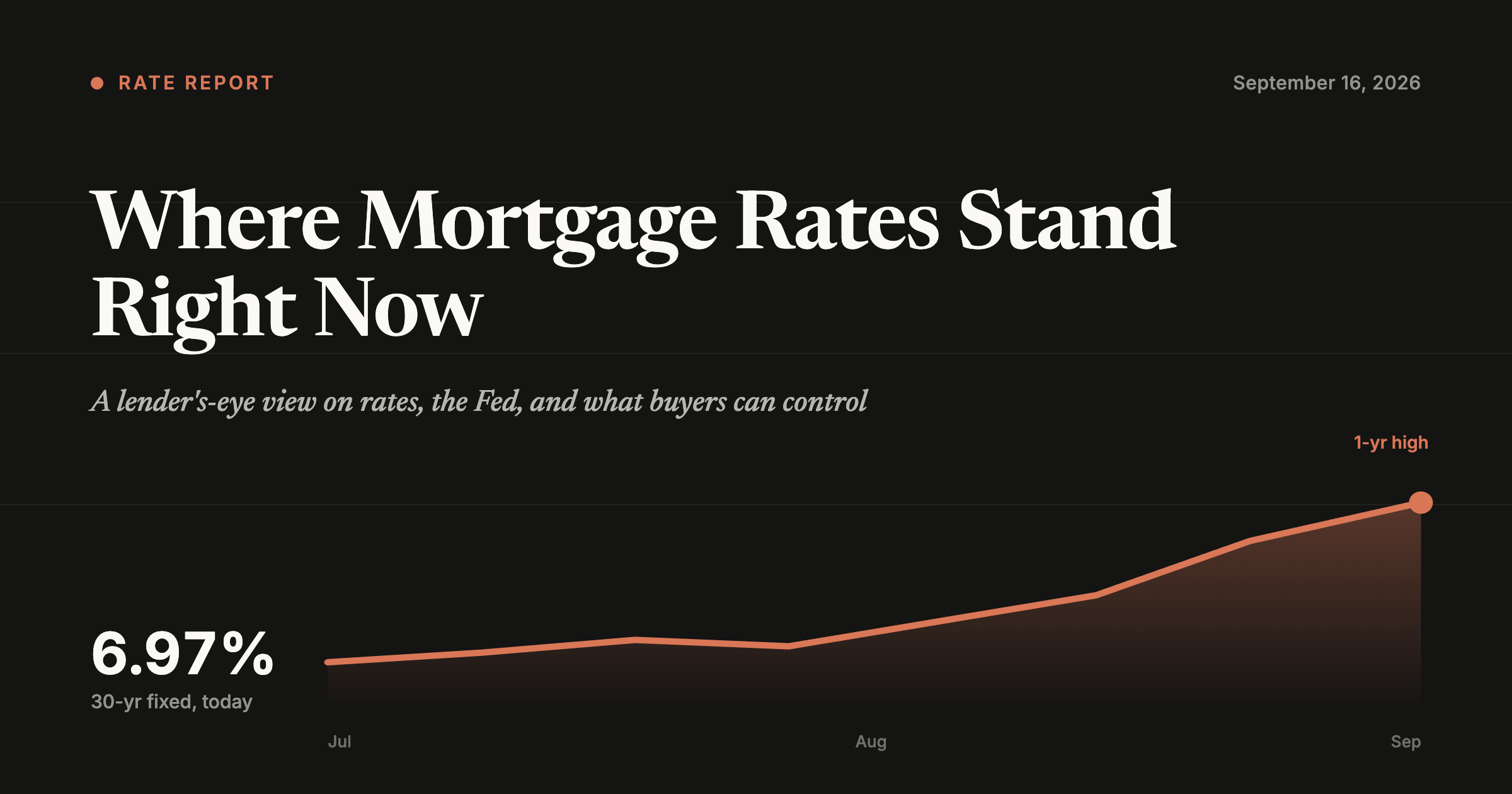
If you've been watching rates this month, you already know it's been a rough stretch. As of today, the 30-year fixed sits close to 7%, with several trackers putting the national average between 6.9% and 7.0% — a one-year high. The 15-year fixed is running in the low-6% range, and 5/1 ARMs have been bouncing around in the high-6s to low-7s depending on the day. It's been a fast, uneven climb: rates have pushed higher for four straight sessions in some surveys, adding roughly 20 basis points in less than two weeks.
Why rates have been climbing
Mortgage rates don't move in lockstep with the Fed's overnight rate — they track much more closely with the 10-year Treasury yield, which reflects what bond investors expect for growth and inflation over the next decade. That yield has been grinding higher, recently touching the 5% mark, its highest level in a year. When investors demand more yield to hold long-term debt, mortgage pricing follows.
The bigger story is timing: today is the second day of the Federal Reserve's September policy meeting, with the rate decision landing at 2:00 p.m. Eastern. Going in, the Fed's benchmark rate has been sitting at 3.5%–3.75%, unchanged since a hold in late July. What's unusual this time is that the conversation isn't only about whether the Fed will cut — some economists think elevated inflation and a still-steady labor market could push the committee toward its first hike since 2023. That kind of uncertainty is exactly what makes bond markets — and mortgage rates — twitchy in the days leading up to a decision.
The outlook for the rest of 2026 and into 2027
Strip out the day-to-day noise, and the professional forecasters are actually fairly aligned on the medium-term picture:
- The Mortgage Bankers Association expects the 30-year fixed to average in the 6.6%–6.7% range through the rest of 2026.
- Fannie Mae's house view is a touch higher, 6.7%–6.8% through year-end.
- Both organizations expect 2027 to look a lot like the second half of 2026 — modest movement, with rates hovering in a similar 6.7%–6.8% band rather than a sharp move in either direction.
In other words: the forecasters were expecting rates to ease back toward the high-6s as the year wound down, not spike toward 7%. This week's run-up is a reminder that short-term swings — driven by a single jobs report, an inflation print, or a Fed meeting — can knock actual rates well off the smooth trend line the forecasts imply. Don't be surprised if rates pull back somewhat once today's Fed decision and press conference are digested, whichever way the vote goes. But don't expect a return to the 5% or 6% rates of a few years ago, either. The days of sub-3% mortgages were a pandemic-era anomaly, not a baseline to wait for.
What this means if you're buying or refinancing
If you're house hunting right now, the temptation is to wait for a "better" rate. Here's the more useful way to think about it: rate timing is largely out of your control, but loan terms, lender selection, and your own financial profile are not. A few things you can act on today:
- Shop multiple lenders, not just one. Rate quotes for the same borrower can vary meaningfully across lenders on the same day — industry data suggests comparing offers can save tens of thousands of dollars over the life of a loan. Get at least three quotes before you commit.
- Push your credit score higher before you apply. Conventional lenders reserve their best pricing for borrowers around a 780 score. Paying down revolving balances and correcting any errors on your credit report a few months before applying can move your rate meaningfully.
- Lower your debt-to-income ratio where you can. Less other debt relative to income signals lower risk to underwriters and can open up better pricing tiers.
- Ask about a temporary buydown or discount points. If a seller or builder is offering concessions, a 1-0 or 2-1 buydown can soften the first year or two of payments while you wait to see if refinancing becomes attractive later.
- Consider an ARM only if you have a clear exit plan. With 5/1 ARMs pricing close to — or even above — 30-year fixed rates in some markets right now, the traditional "cheaper upfront" argument for an ARM is weaker than usual. It only makes sense if you're confident you'll sell or refinance before the adjustment period hits.
- Lock your rate once you're comfortable with it, and ask about a float-down option. In a week like this one, a rate lock with the ability to float down if rates drop before closing gives you protection in both directions.
If you already have a mortgage, refinancing isn't automatically off the table just because headline rates ticked up this week. Refinance applications are up sharply year-over-year because rates are still meaningfully below where they were in late spring. The rule of thumb many lenders use is that refinancing starts to make sense once you can shave at least 0.75–1% off your current rate — but the real answer depends on your break-even point after closing costs and how long you plan to stay in the home. Run the math on your specific loan rather than reacting to the headline number.
The bottom line
Rates near 7% feel jarring after a summer of relief, and today's Fed decision adds a genuine wildcard to the next few weeks. But the forecasts that matter for planning a purchase — MBA's and Fannie Mae's — still point to rates settling back into the high-6% range over the medium term rather than continuing to climb. If you're waiting for a dramatically better environment, you may be waiting through more of these short-term spikes than you'd like. The more productive move is to control what you can: your credit, your lender shopping, your loan structure — and treat the Fed headlines as noise to monitor, not a reason to freeze.
Rates and forecasts cited here reflect data available as of September 16, 2026, and will move as new economic data and Fed communications come in. Talk to a licensed loan officer about your specific numbers before locking anything in.

Emily Hayes
CEO Emily Hayes Homes | Emily Hayes Homes | Keller Williams | PLACE
or another way